Rental Property Tax Checklist
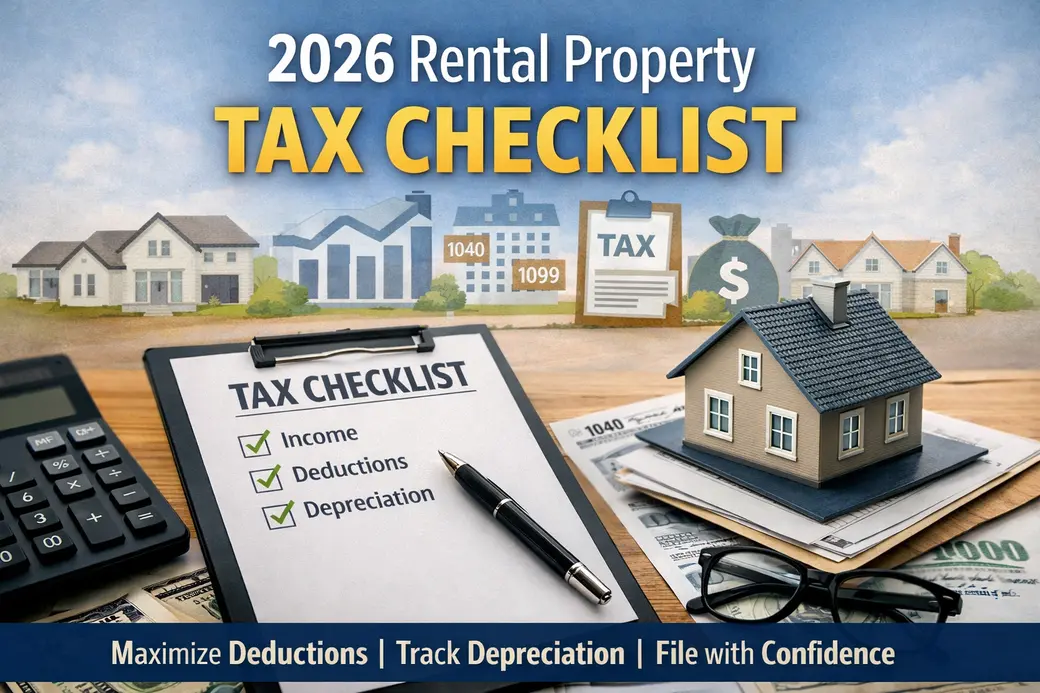
Rental Property Tax Checklist
Essential filing moves that protect cash flow, reduce risk, and keep your portfolio bank-ready.
If rental taxes feel like a once-a-year headache, you’re not alone. But here’s the truth: strong landlords don’t “do taxes.” They run a tax-ready system all year.
And in 2026, that matters even more. Rental returns are detail-heavy. One wrong classification can cost you deductions, create reporting issues, or make a lender’s underwriter start asking “fun questions.” (Nothing says party like an underwriter with follow-ups.)
This checklist keeps you organized, deduction-ready, and audit-resistant — without making you become a CPA.
What You’ll Learn
-
The core reports and records every landlord should have ready
-
The biggest tax mistakes landlords make (and how to avoid them)
-
How to stay clean on repairs vs. improvements
-
Depreciation basics you need to verify, not guess
-
The contractor/W-9/1099 workflow that saves you in January
The 2026 Rental Property Tax Checklist
1) Confirm your rental income numbers first
Start with income because it anchors everything else.
Make sure you can support:
-
Rent collected (including partial payments and late fees)
-
Prorated rent (move-ins / move-outs)
-
Other rental-related fees (where applicable)
-
Security deposits (these aren’t automatically “income” — treatment depends on circumstances)
Best practice: reconcile your rent ledger against actual bank deposits monthly. If you do that, tax season becomes paperwork… not panic.
2) Categorize deductible expenses like you expect to defend them
Landlords don’t usually lose money from “missing deductions.” They lose money from messy records.
Review common expense buckets:
-
Repairs and maintenance
-
Insurance
-
Utilities you paid
-
Professional services (legal/accounting)
-
Software and admin tools
-
Mileage/travel (when applicable)
-
Home office (only if you legitimately qualify)
Keep receipts and invoices for everything. The IRS cares less about your intentions and more about your documentation. IRS Publication 527 is a key reference for rental owners.
Source: https://www.irs.gov/publications/p527
3) Get repairs vs. improvements right (this is where people get burned)
This line is the difference between:
-
Repairs (often current-year deductions), and
-
Improvements (typically capitalized and depreciated)
If you’re upgrading kitchens, replacing roofs, installing new systems, or doing major renos — document it clearly and keep notes with the invoice.
Source (IRS guidance on rentals): https://www.irs.gov/pub/irs-pdf/p527.pdf
4) Review depreciation schedules (don’t leave money on the table)
Depreciation is one of real estate’s biggest wealth advantages… when it’s correct.
Verify:
-
Basis allocation (land vs. building)
-
Correct in-service dates
-
Capital improvements added properly
-
Depreciation treatment for residential rental property (commonly 27.5 years)
Source (IRS rental depreciation FAQs): https://www.irs.gov/faqs/sale-or-trade-of-business-depreciation-rentals
If you converted a primary residence into a rental, inherited property, or did a major rehab, that’s a strong reason to have your CPA double-check the schedule.
5) Know the key forms you’ll likely touch
Even if your CPA handles the filing, you should understand the basics.
Most landlords will use:
-
Schedule E (Form 1040) for rental income and expenses
Source: https://www.irs.gov/forms-pubs/about-schedule-e-form-1040
-
Form 4562 for depreciation and amortization
Source: https://www.irs.gov/forms-pubs/about-form-4562
This isn’t about DIY taxes — it’s about running clean books so filing is smooth and strategic.
6) Contractors: collect W-9s early and clean up 1099 prep
If you pay contractors, don’t wait until January to figure out who you paid and why your list is missing addresses.
Your workflow should be:
-
Collect W-9s up front
-
Track contractor payments consistently
-
Confirm who needs reporting before year-end
Source: https://www.irs.gov/businesses/small-businesses-self-employed/reporting-payments-to-independent-contractors
For Form 1099-NEC rules and thresholds, see:
Source: https://www.irs.gov/faqs/small-business-self-employed-other-business/form-1099-nec-independent-contractors/form-1099-nec-independent-contractors
7) Audit-proof your recordkeeping (because “trust me” isn’t a strategy)
The IRS doesn’t demand perfect bookkeeping. It demands supportable bookkeeping.
Your minimum standard:
-
Digital receipts/invoices (no shoebox archaeology)
-
Property-level expense tracking
-
Monthly reconciliation
-
Separation of rental finances (bank/credit) when possible
Side benefit: cleaner books also make lending easier. Underwriters love tidy numbers.
8) Run year-end reports before you file
Before you send anything to your CPA, generate:
-
P&L by property
-
Expense breakdown by category
-
Rent roll / payment history
-
Simple cash flow summary
Then ask your CPA one powerful question:
“What should I change this year to improve next year’s tax outcome?”
That’s how you move from filing taxes to optimizing your portfolio.
Quick 2026 Landlord Tax Tips (the short list that saves money)
-
Don’t wait until March
-
Track monthly, not annually
-
Separate banking if possible
-
Document improvements the day they happen
-
Use categories that mirror Schedule E
The Bigger Picture
Taxes are not just compliance. They’re leverage.
-
Better documentation can protect deductions
-
Correct depreciation improves long-term returns
-
Clean reporting improves lender confidence
-
Strong systems reduce stress and increase deal-readiness
A practical 2026 goal:
Be the landlord whose books are always ready — because opportunity doesn’t wait for your spreadsheet.
Want a simple checklist you can reuse monthly?
If you want, I can format this into a one-page printable checklist (PDF) and a monthly landlord bookkeeping rhythm you can hand to a VA or property manager.
Sources
-
https://rentredi.com/blog/2026-rental-property-tax-checklist/
-
https://www.irs.gov/publications/p527
-
https://www.irs.gov/pub/irs-pdf/p527.pdf
-
https://www.irs.gov/forms-pubs/about-schedule-e-form-1040
-
https://www.irs.gov/pub/irs-pdf/i1040se.pdf
-
https://www.irs.gov/forms-pubs/about-form-4562
-
https://www.irs.gov/instructions/i4562
-
https://www.irs.gov/faqs/sale-or-trade-of-business-depreciation-rentals
-
https://www.irs.gov/businesses/small-businesses-self-employed/reporting-payments-to-independent-contractors
-
https://www.irs.gov/faqs/small-business-self-employed-other-business/form-1099-nec-independent-contractors/form-1099-nec-independent-contractors
-
https://www.irs.gov/instructions/i1099mec
-
https://www.irs.gov/filing/individuals/when-to-file
Categories
Recent Posts